

How to Save for College When You Have No Idea What College Will Look Like
For context, as of this writing (July 2026), my kids haven't even started kindergarten yet.
The daycare bills have yet to fully roll off the books, interests and personalities are still forming, and while diapers and formula costs have dropped, costs for real people food and activities are all ticking up. Projecting out where they'll land at the end of their educational journey, what they'll want to study, what skills will be valuable, what "college" even means by then, and importantly, how much we should save to help support any of this, can feel downright impossible.
Will they want a four-year university? Or will they lean toward a trade program, or community college, or starting a business? Maybe they’ll get a scholarship that changes the whole picture? Or, maybe AI will make all these potential options sound quaint and outdated, relics of a simpler time, when my kids are making these decisions.
I don't know. You probably don't either. And pretending otherwise is where a lot of college savings plans go sideways.
Some plans are too rigid and anchored to assumptions made when the kid was three years old. Others, the planning ended before it really even began. The decision to begin funding the child’s future, even just a little bit, felt too big, too unknown, too far away, or too overwhelming.
Both versions can be a mistake. Just because we don't know the final destination doesn't mean there aren't productive and proactive choices that we can make today. It largely comes down to being flexible and willing to recalibrate along the way (ah, see what I did there…).
So, how might you think about building a college savings approach that's flexible enough to support an uncertain future?
Why a 529 May Be Worth Opening (Even with All That Uncertainty)
A 529 is a tax-advantaged savings account designed for education expenses. Earnings grow tax-free, withdrawals for qualified expenses are tax-free, and the account is flexible enough to cover college, trade school, or even roll into a Roth IRA if your child doesn't need it. Some states even offer a tax deduction or credit on contributions (California is not one of them unfortunately, which is worth noting for folks in my home state).
The headline benefit is the tax-free growth, and investments compounding over a longer time horizon doing a lot of the heavy lifting. Interestingly though, 529s can offer some flexibility as well, if future plans evolve or change:
You could consider changing the beneficiary to a sibling or another family member
If your child gets a scholarship, you can still withdraw up to the scholarship amount penalty-free (income tax on earnings would still apply)
If excess funds remained in the 529, you could consider rolling a portion into a Roth IRA for the beneficiary (limitations and timing rules apply)
The Case for a Brokerage Account: Flexibility Above All Else
While a 529 is optimized for education, having a well-funded taxable brokerage account in the mix changes the flexibility profile of not just your college saving goals, but your whole financial plan. You can invest funds, grow them over time, and ultimately use them for anything: college, a down payment, starting a business, a gap year, or your own retirement and future spending goals.
Yes, you give up the dedicated tax-free growth and withdrawal benefit, if used for education expenses. Investments you sell out of a brokerage account to fund a goal will likely result in taxable gains. But what you lose in tax efficiency you could gain back in increased optionality. Flexibility can be a great asset when the future is genuinely unclear.
This is also where the "put your own mask on first" principle comes into focus. The brokerage account doesn't force you to choose between saving for your kid and saving for yourself. If their plans change, those funds aren’t penalized or otherwise restricted, they fold right back into your own financial picture.
Something worth remembering is that your kids can borrow for college. You can't borrow for retirement. A brokerage account held by you as the parent keeps both doors open, which is exactly the kind of flexibility that creates real options down the road.
So How Much Should We Save?
Short answer is, it depends. (Hey, what kind of answer is that!?)
But the truth is, college planning is deeply personal and there is no one-size-fits-all “right” answer.
Some families may want to cover everything and give their kids a debt-free start. Others think some financial responsibility is part of the education. Still others may rely on family support or other aid. And for couples, this is a conversation worth having together early, because two partners don't always start from the same place on how much they want to cover or how to weigh it against other goals they're already saving for.
A few questions that can help to shape the initial strategy and conversation:
How much do you want to cover? Do you want the student to have some “skin in the game”?
What type of school are you planning for? In-state public looks very different from private.
Are there other resources in the picture, like family support, merit aid, etc.?
How much flexibility do you want to preserve in your broader financial picture?
Once you begin to answer some of these questions, even in a general sense, you can start to hone in on whether saving with a 529 account, a brokerage account, or a mix of the two, might make the most sense for your situation.
Personally, I tend to value flexibility, so for my family I’ve prioritized early savings into 529 accounts (to maximize the time the accounts can grow tax-free), with supplemental savings into a brokerage account (that can be used more flexibly, as needed, once estimated costs become better known). This isn’t a recommendation for your specific situation, but just an example of one perspective and approach.
Start Early If Possible
Starting early matters, not because you have to hit some perfect number by freshman year, but because the more time you give those investments to grow, the more optionality you may have later. You can always pull back on contributions as the picture clarifies. But you can't manufacture time you didn't use.
To illustrate with an example, let’s say you start saving $200 a month once your child is 5 and the daycare costs start to fall off. We’ll assume you invest monthly, for 13 years until the child is 18, and that you receive an 8% average annual return. These savings would grow to roughly $55,000, on total contributions of about $31,200.* And while maybe that’s not the college bill covered in full, it's a meaningful foundation built on a relatively modest monthly commitment.
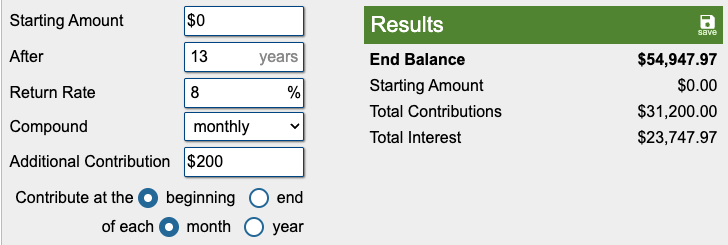
*For illustrative purposes only. This does not represent a guaranteed return or a prediction of future performance. Actual results will vary.
Change the variables as you see fit using an online calculator (like this one), but the core premise remains the same. Whether you start saving when the child is 2 or 12, save $100 per month or $1,000, getting started with something early can prove to have an outsized benefit down the road.
You don't need firm answers today. Pick a rough number to head towards, identify the timeline you’re working toward that number on, and settle on a savings amount that you can commit to now.
Your next best step might just be directional clarity and settling on an initial investment to get started with, and that’s a win.
Getting Started Is the Point
I’ll say this again, because it bears repeating. You can't turn back the clock and manufacture time you didn't use. Starting with something, even if it's modest, puts time on your side in a way that waiting doesn't.
If you’re already saving for your child(ren), great! Check in on the investment allocation of their accounts and assess whether your contribution amount still reflects your goals.
If you haven't started saving yet, take a close look at what you might be able to afford. Try to get started now, even if the commitment is small. Even a modest, but consistent, contribution started now can prove to be a sizable head-start down the road.
Above all else, just remember, none of us can predict the future. The simple truth is that all of this will likely change. But we don’t need to predict the future to take some action today, or to start building some flexibility into your plan that will give future you more options.
Start early, stay flexible, and adjust as you go. You got this.
This post is for informational purposes only and is not investment, tax, or legal advice. Please consult a qualified professional for guidance specific to your situation. The saving illustration is a hypothetical example using assumed figures and is intended for educational purposes only. Past performance does not guarantee future results.