

Cash Flow Is the Oxygen of Your Financial Plan
Pick a goal that asks something of your body: run a half marathon, swim more than a few laps in the pool, climb up to the top of a mountain you've been eyeing for years. Your gear can be dialed in, but if you skipped building the fitness and can't breathe once you're out there, none of it gets you anywhere. Oxygen is one thing your body can't live without, and any demand you put on your body depends on it.
And when it comes to your finances, cash flow is the oxygen of your financial plan. It's one of the first things I dig into with any new client, before we build a single projection or commit to any planning recommendation or strategy.
We start with what you’re earning, saving, and spending already to establish a baseline. Because if your cash flow is all out of alignment, running a deficit some months without quite knowing why, no plan on paper, however good, is actionable until there's actual money left over to point at it.
What a Cash Flow Analysis Actually Is (and What It Isn't)
First, what this isn't: a shame game. It's not designed to label your spending as good or bad, or to make a someone feel judged about a new car payment or a takeout habit that crept in during a busy stretch.
It’s not my place to tell someone what to spend or not spend their money on. That’s their business and it’s for them to decide based on what they value most. Where I come in is helping them to become more aware of what they’re spending and spending on.
Very few people track or monitor their spending in any tangible way, so the point here is simply to bring some visibility to it. That's our starting point.
Usually the informal system I see looks at the onset is something like this: money lands in a checking account, and as long as the balance doesn't dip below a certain water mark ($2,000, $5,000, $10,000) the assumption is that spending must be under control.
Dip below it, tighten the belt next month. Rise too far above it, now they’ve got to decide what to do with the excess: save it for the future…or perhaps spend it on a fun trip or some new furniture. Either way, the pattern repeats for years without a clear sense of what's being spent or saved, or what the ultimate goal even is. They’re getting by, as long as nothing unexpected throws the system out of whack.
I see this dynamic all the time with the families I meet with. Two solid incomes, a mortgage, a toddler (or two) in daycare that costs as much each month as a second mortgage payment. When I ask what they spend in a typical month, the answer gets fuzzy though. We can usually piece together a few of the big things, but then there's usually a very large and very unknown "everything else that's not easy to keep track of because we're two exhausted parents juggling our jobs, family, and we have two kids in daycare, didn't you hear that?" bucket of expenses.
Often this ends up being a clarity problem. There’s a mismatch between what they think they're spending and what they actually are, and that mismatch is creating stress. The good news is: it’s fixable.
What Getting Clear on Cash Flow Actually Means
At the most basic level, getting clear on cash flow simply means understanding what's coming in, what is being kept (saved), and what's going out.
First, we take a look at income: Partner 1’s salary, Partner 2’s salary, and any other income they regularly receive.
Next, we look at whatever they already save on a regular basis: 401k contributions, a planned home project fund, a transfer to a kid's 529.
Finally, we estimate roughly how much is going back out to cover everything they spend on in a given month. If details aren’t available, that’s ok, we start high level at first.
I’ll typically split expenses into two buckets. Fixed expenses are those that rarely move month to month: rent or mortgage, fixed housing costs, insurance, childcare, debt payments like a car loan or student loans, etc.
Variable expenses are the “everything else,” and at a high level, the goal is first just getting a general sense of whether they’re spending, for example, $5,000 a month, or is it closer to $8,000? This number can be surprising to folks.
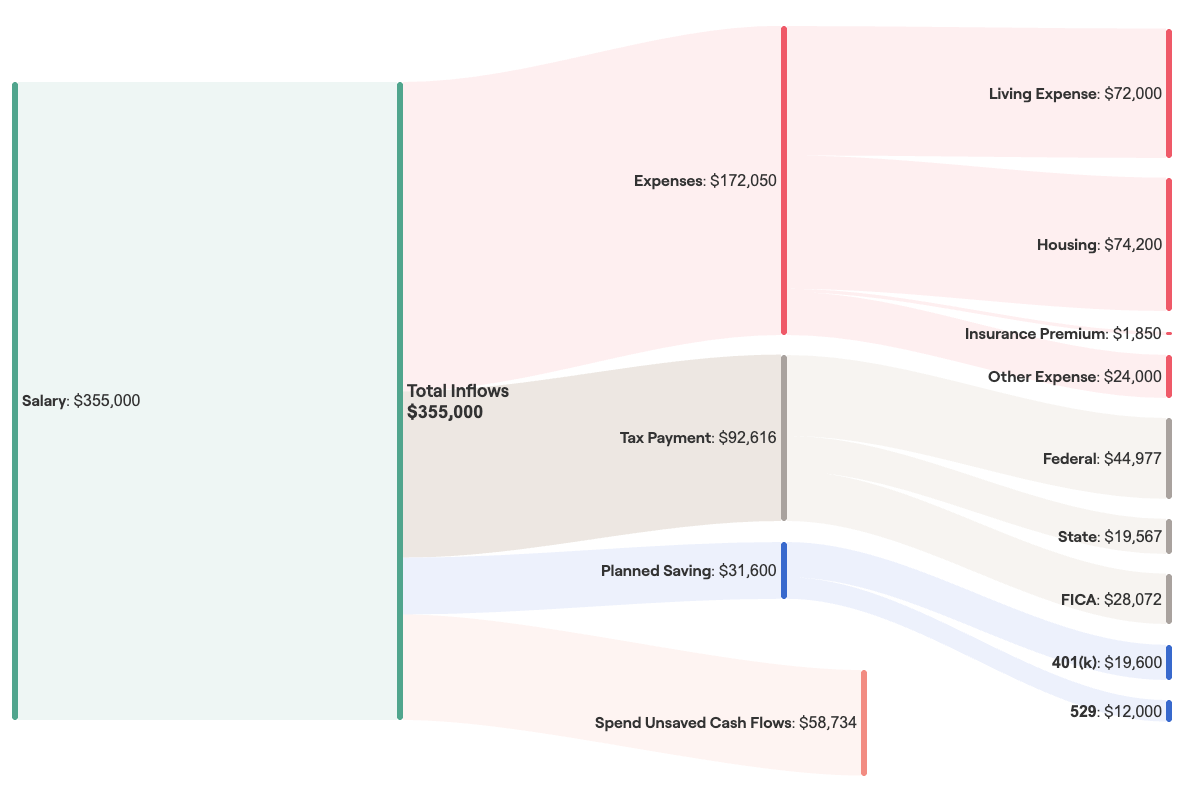
Once we have a sense of what's coming in and going out, we create a picture (like in the example below) to look at what's left over, and this is where the first gut check happens.
If the picture says they should have ~$50,000 a year available, after they’ve paid for all their estimated expenses, does that track? Is that consistent with the lived experience? Or does it feel more like there is only $15,000 left typically? Or $5,000? Or are they sitting there looking at this diagram thinking, “wait, it says here there should be money left over?”
Example 1 - A hypothetical planning illustration showing excess cash flow. How exciting! This surplus presents real opportunity to save and invest toward goals like a down payment, a college fund, or retirement. All figures shown are estimates and illustrative only.
If the gut check felt roughly accurate, and there's money to spare, they may already be ready to move deeper into more detailed planning: strategizing around the excess cash flow, identifying and building toward goals, refining investment and tax strategies, etc. They may still find value in the additional refinements below though, since they could further free up additional cash flow to spend in alignment with their values, or to direct toward their goals more intentionally.
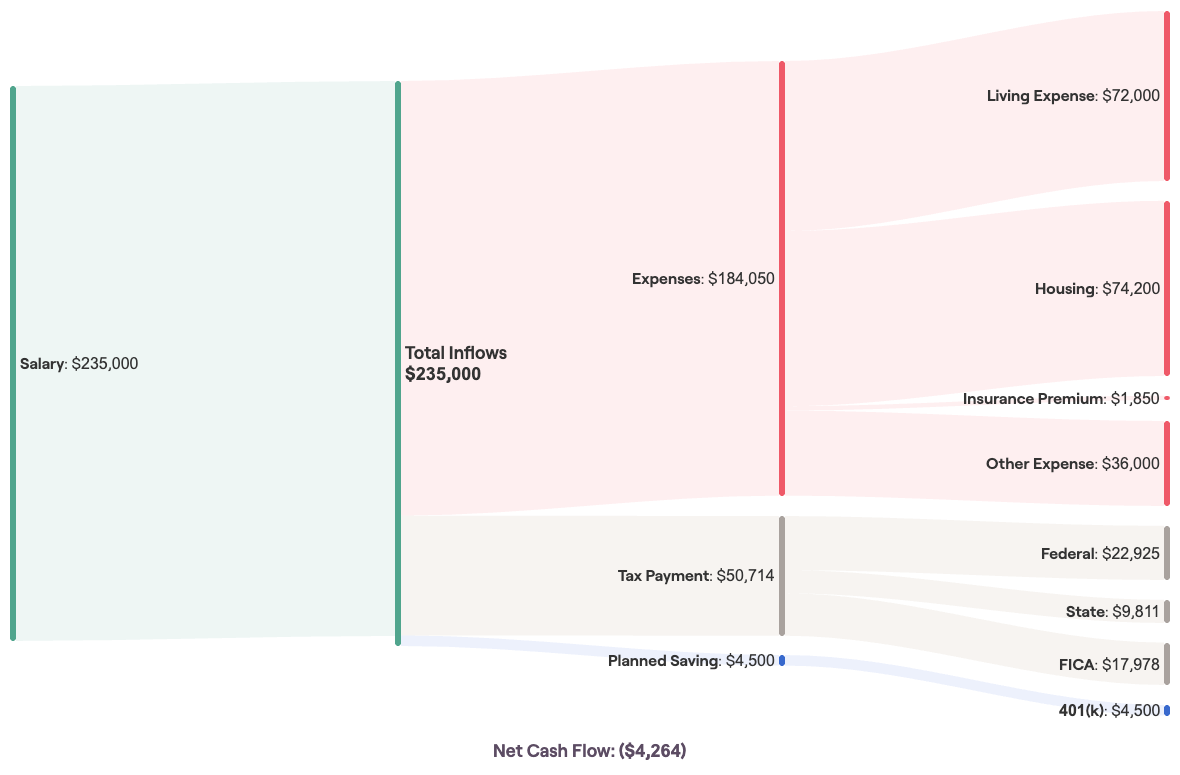
But if the picture still feels murky, and there are questions about where the money is going (like in the example below), then this next piece is that much more important.
Example 2 - A hypothetical illustration of a family with little to no excess cash flow. We’ll need to dig deeper into spending to identify where excess cash flow could be freed up if they want to pursue and fund future goals. All figures shown are estimates and illustrative only.
This is where tracking expenses with more intention comes in. While detailed budgeting can be a great fit for some people, many other folks have a visceral, negative reaction to the word “budget.” So, generally, except in extreme circumstances, I recommend starting first with tracking spending each month, with a goal of creating general awareness of spending.
An account aggregation tool is the easiest way to do this (RIP Mint.com…but there are other solid options), or a simple spreadsheet can work too. Note what ran higher than usual and watch the trends over 3-6 months.
Did travel expenses spike? Maybe it was because hotels and flights for a future trip were booked. Nothing to worry about.
Or maybe the grocery/food line item is creeping up? Perhaps that's worth watching, or maybe it's normal because the kids are growing and (like mine) are eating something like 20-50 pounds of expensive berries every month.
Does Your Spending Match What You Say You Value?
Once the spending has been tracked, we’ll step back and look at it, without judgment, through a value lens. Does the spending line up with what they value and what their family actually cares about? And if they’re unsure of what they care most about? We’ll spend 5-10 minutes on a values exercise (like this one) to get some clarity.
Is the story their spending is telling one they’re happy with?
If travel and experience are what they value most, but the money keeps disappearing into new clothes, eating out, or expensive subscriptions or memberships they aren’t using often enough, maybe that's worth a second look.
Ultimately I want to help encourage folks to spend on what they value. Heck, spend more on it even, if they can afford to. I'm not here to tell them that every dollar they touch must be saved. Rather, I encourage them to review the categories they're spending in but don't value much, and then cut ruthlessly there. That's one way they can start to build real margin in their cash flow.
Only once they’ve gone through this exercise will they have an honest sense of their spending, and by extension their cash flow. That's when they can act: trimming what doesn't serve them and redirecting it toward a goal, recognizing that their lifestyle has outpaced their income, or simply confirming they’re already spending in alignment with what they value most.
If their spending is dialed in and in alignment with what they value, heck yeah, keep going. That's what the money is for.
If it's not, then now we have more data than we had before, and we can begin to assess tradeoffs and options to help close the gap.
Where to Start on Your Own
If you're ready to get clear on your own cash flow picture or ready to start making some changes, there's quite a bit you can do on your own before you ever need to bring in a professional. A few common starting points:
Track your spending. An account aggregator, a spreadsheet, whatever method sticks. Keep it light, around 15 minutes a month, and only go as granular as is useful to you, not more.
Compare your spending to your values. Are you spending in alignment with what you value most? Are there areas where your spending may have grown over time due to momentum, not intention?
Simplify your account structure. A paycheck landing in one account, a bill auto-paying from another, a partner's paycheck landing somewhere else entirely: that kind of sprawl is often the actual source of confusion, more than the spending itself. Where you can, consolidate to one checking account for everything coming in and going out, close old cards or accounts you don't need, and pick a bank with a competitive rate and stay put. Chasing a $200 sign-up bonus or an extra 0.3% in interest is rarely worth the fragmentation.
Consider separate accounts for specific goals. This sounds like it contradicts the point above, but the idea is intentionality: emergency savings, a vacation fund, a future down payment, each in its own place (or even at a separate bank), can create just enough friction to keep you from raiding it on impulse. Same logic as not keeping sweets in the house when you're trying to eat better.
Pay yourself first, and automate everything you can. Retirement accounts, investment accounts, an emergency fund, a kid's college fund: send money there before anything else. Automate it so the decision gets made once, not every month. Whatever's left is what funds your life, which you can spend without guilt, because you’ve already funded what’s important.
Understanding your cash flow is a worthy goal. It's the oxygen of any financial plan. It doesn't replace the need for the retirement projection, the tax and investment strategy, or the savings plan for the life you're actually trying to build, but it’s what lets all of it breathe. Get that part right, and the rest of the plan finally has the room to do what it's supposed to do.
Get the right things right, then go live your life. Now that's a breath of fresh air.
This post is for informational purposes only and is not investment, tax, or legal advice. Please consult a qualified professional for guidance specific to your situation.